


MSI GeForce RTX 5070 GAMING DUKE 3X OC WHITE
Benchmark and Specs
Last updated:
Benchmark and Specs
All technical data and various benchmarks of the MSI GeForce RTX 5070 GAMING DUKE 3X OC WHITE are listed on this page. The graphics card is based on the GB205-300-A1 (Blackwell) graphics chip, which is manufactured with a structure width of 5 nm. The MSI GeForce RTX 5070 GAMING DUKE 3X OC WHITE can operate up to 4 screens with a maximum resolution of up to 7680x4320 become.
GPUThe MSI GeForce RTX 5070 GAMING DUKE 3X OC WHITE has 48 execution units with 6144 shaders. This gives the graphics card a theoretical FP32 computing power of 31.60 TFLOPS. |
|
| Based on: | NVIDIA GeForce RTX 5070 |
| GPU Chip: | GB205-300-A1 (Blackwell) |
| Streaming Multiprocessors: | 48 |
| Shader: | 6144 |
| Render Output Units: | 64 |
| Texture Units: | 192 |
| Raytracing Cores: | 48 |
MemoryThe MSI GeForce RTX 5070 GAMING DUKE 3X OC WHITE is equipped with 12 GB graphics memory of the type GDDR7. The memory clock of the graphics card is 1.750 GHz and the speed is 28 Gbps. |
|
| Memory Size: | 12 GB |
| Memory Type: | GDDR7 |
| Memory Clock: | 1.750 GHz |
| Memory Speed: | 28.0 Gbps |
| Memory bandwidth: | 672 GB/s |
| Memory Interface: | 192 bit |
Clock SpeedsThe base frequency of this graphics card is 2.165 GHz and the manufacturer specifies the maximum turbo clock as 2.572 GHz. If supported (see below), the performance can be further increased by overclocking. |
|
| Base Clock: | 2.165 GHz |
| Boost Clock: | 2.572 GHz + 2 % + 2 % |
| Avg (Game) Clock: | |
| Overclocking: | Yes |
Thermal DesignThe MSI GeForce RTX 5070 GAMING DUKE 3X OC WHITE is powered by 1 x 16-Pin connectors. The TDP (Thermal Design Power) of the graphics card is 250 W. |
|
| TDP: | 250 W |
| TDP (up): | -- |
| Tjunction max: | 85 °C |
| PCIe-Power: | 1 x 16-Pin |
Cooler & FansGraphics processor and graphics memory of the MSI GeForce RTX 5070 GAMING DUKE 3X OC WHITE are cooled by a Air cooling. |
|
| Fan-Type: | Axial |
| Fan 1: | 3 x 90 mm |
| Fan 2: | -- |
| Cooler-Type: | Air cooling |
| Noise (Idle): | 0 dB / Silent |
| Noise (Load): | -- |
ConnectivityUp to 4 monitors can be operated with the MSI GeForce RTX 5070 GAMING DUKE 3X OC WHITE. |
|
| Max. Displays: | 4 |
| HDCP-Version: | 2.3 |
| HDMI Ports: | 1x HDMI v2.1b |
| DP Ports: | 3x DP v2.1b |
| DVI Ports: | -- |
| VGA Ports: | -- |
| USB-C Ports: | -- |
FeaturesetWith the MSI GeForce RTX 5070 GAMING DUKE 3X OC WHITE it is possible to operate a screen with a resolution of up to 7680x4320 pixels. Furthermore, the DirectX standard version 12_2 (Ultimate) is supported. |
|
| Max. resolution: | 7680x4320 |
| DirectX: | 12_2 (Ultimate) |
| Raytracing: | Yes |
| DLSS / FSR: | Yes |
| LED: | No LED lighting |
Supported Video CodecsThis area lists the video codecs that the MSI GeForce RTX 5070 GAMING DUKE 3X OC WHITE can decode or encode in hardware in order to minimize the processor load, which leads to lower power consumption. |
|
| h264: | Decode / Encode |
| h265 / HEVC: | Decode / Encode |
| VP8: | Decode / Encode |
| VP9: | Decode / Encode |
| AV1: | Decode / Encode |
DimensionsThe MSI GeForce RTX 5070 GAMING DUKE 3X OC WHITE needs the space of 3 PCIe-Slots in a case. It is 325 mm long, 121 mm high and 45 mm wide. |
|
| Length: | 325 mm |
| Height: | 121 mm |
| Width: | 45 mm |
| Width (Slots): | 3 PCIe-Slots |
| Weight: | -- |
| SFF-Ready: | No |
Additional dataThe MSI GeForce RTX 5070 GAMING DUKE 3X OC WHITE was released in Q2/2025 at a price of 549 $ (Reference). The graphics card manufactured in 5 nm is connected to the system via PCIe 5 x 16 lanes. |
|
| GPU Interface: | PCIe 5 x 16 |
| Release date: | Q2/2025 |
| Launch Price: | 549 $ (Reference) |
| Structure size: | 5 nm |
| Part-no: | -- |
| Documents: | data sheet |
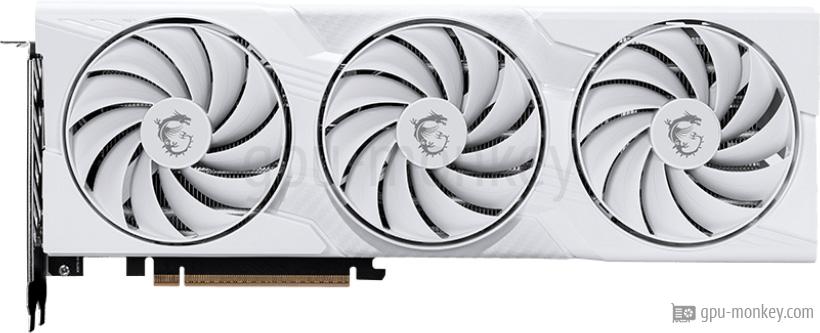
2.165 GHz, 12 GB (250 W TDP)
Buy this graphic card at amazon!

Rate this graphics card
Benchmark results
3DMark Benchmark (DirectX, Raytracing)
3DMark is a benchmark program that determines the performance of certain components of a computer and then reports the performance as a numerical value.
Time Spy Extreme Graphics score

|
MSI GeForce RTX 5070 GAMING DUKE 3X OC WHITE
12 GB GDDR7 |
||

|
NVIDIA GeForce RTX 5070
Average of gpu group |
||
Steel Nomad Light Graphics score
|
|
MSI GeForce RTX 5070 GAMING DUKE 3X OC WHITE
12 GB GDDR7 |
||
|
|
NVIDIA GeForce RTX 5070
Average of gpu group |
||
Steel Nomad Graphics score
|
|
MSI GeForce RTX 5070 GAMING DUKE 3X OC WHITE
12 GB GDDR7 |
||
|
|
NVIDIA GeForce RTX 5070
Average of gpu group |
||
Port Royal (Raytracing)
|
|
MSI GeForce RTX 5070 GAMING DUKE 3X OC WHITE
12 GB GDDR7 |
||
|
|
NVIDIA GeForce RTX 5070
Average of gpu group |
||
Speed Way Graphics Score (Raytracing)
|
|
MSI GeForce RTX 5070 GAMING DUKE 3X OC WHITE
12 GB GDDR7 |
||
|
|
NVIDIA GeForce RTX 5070
Average of gpu group |
||
Solar Bay (Raytracing)
|
|
MSI GeForce RTX 5070 GAMING DUKE 3X OC WHITE
12 GB GDDR7 |
||
|
|
NVIDIA GeForce RTX 5070
Average of gpu group |
||
FP32 Performance (Single-precision TFLOPS)
The theoretical computing power of the graphics card with single precision (32 bit) in TFLOPS indicates how many trillion FP32 floating point operations the graphics card (GPU) can perform per second.
FP32 (TFLOPS)
|
|
MSI GeForce RTX 5070 GAMING DUKE 3X OC WHITE
12 GB GDDR7 |
||
More benchmarks
In order to determine the performance of a graphics card, so-called "benchmarks" are carried out. The benchmark software carries out special calculations to determine the performance of a graphics card. We use so-called theoretical or synthetic benchmarks (e.g. 3D Mark) as well as real game benchmarks. To ensure real comparability of the results, we pay attention to the correct execution of the benchmarks as well as the condition of the graphics card and the system.We use the following benchmarks to measure the performance of a graphics card:


Popular comparisons


