


Gainward GeForce RTX 2070
vs
PNY GeForce GTX 980 Ti
GPU comparison with benchmarksThe Gainward GeForce RTX 2070 has 2304 shader units and these clock a maximum of 1.62 GHz which results in an FP32 computing power of 7.46 TFLOPS.
The PNY GeForce GTX 980 Ti has 2816 shader units and these clock at a maximum of 1.08 GHz and achieve an FP32 computing power of 6.06 TFLOPS. |
||
GPUThe Gainward GeForce RTX 2070 is equipped with a graphics chip of the Turing architecture, which has 36 streaming multiprocessors. The graphics card PNY GeForce GTX 980 Ti is based on the Maxwell 2.0 architecture and is equipped with 22 execution units. |
||
| Gainward GeForce RTX 2070 | GPU | PNY GeForce GTX 980 Ti |
| NVIDIA GeForce RTX 2070 | Based on | NVIDIA GeForce GTX 980 Ti |
| TU106 | GPU Chip | GM200-310-A1 |
| Turing | Architecture | Maxwell 2.0 |
| 36 | Streaming Multiprocessors | 22 |
| 2304 | Shader | 2816 |
| 64 | Render Output Units | 96 |
| 144 | Texture Units | 176 |
| 36 | Raytracing Cores | 0 |
MemoryThe Gainward GeForce RTX 2070 is equipped with a 8 GB large GDDR6 graphics memory, which is equipped with 1.750 GHz clocks. The PNY GeForce GTX 980 Ti has a 6 GB large GDDR5 graphics memory and the memory clock is 1.753GHz. |
||
| 8 GB | Memory Size | 6 GB |
| GDDR6 | Memory Type | GDDR5 |
| 1.750 GHz | Memory Clock | 1.753 GHz |
| 14.0 Gbps | Memory Speed | 7.0 Gbps |
| 448 GB/s | Memory bandwidth | 337 GB/s |
| 256 bit | Memory Interface | 384 bit |
Clock SpeedsThe Gainward GeForce RTX 2070 has a turbo clock of 1.620 GHz. The turbo frequency of the PNY GeForce GTX 980 Ti is 1.076 GHz. |
||
| 1.410 GHz | Base Clock | 1.000 GHz |
| 1.620 GHz | Boost Clock | 1.076 GHz |
| Avg (Game) Clock | ||
| Yes | Overclocking | Yes |
Thermal DesignThe Gainward GeForce RTX 2070 has 1 x 8-Pin connectors through which it is supplied with power. The manufacturer specifies the maximum operating temperature of the graphics card as 89 °C. The PNY GeForce GTX 980 Ti is equipped with a 1 x 6-Pin, 1 x 8-Pin PCIe power connector that supplies it with power. The maximum operating temperature of the card is 91 °C. |
||
| 175 W | TDP | 250 W |
| -- | TDP (up) | -- |
| 89 °C | Tjunction max | 91 °C |
| 1 x 8-Pin | PCIe-Power | 1 x 6-Pin, 1 x 8-Pin |
Cooler & FansThe graphics processor and graphics memory of the Gainward GeForce RTX 2070 are cooled with a Air cooling. The PNY GeForce GTX 980 Ti is cooled by a Air cooling. |
||
| Axial | Fan-Type | Radial |
| 2 x 90 mm | Fan 1 | 1 x 65 mm |
| -- | Fan 2 | -- |
| Air cooling | Cooler-Type | Air cooling |
| 0 dB | Noise (Idle) | 0 dB |
| -- | Noise (Load) | -- |
ConnectivityThe Gainward GeForce RTX 2070 supports the downward compatible copy protection HDCP in version 2.2. The PNY GeForce GTX 980 Ti supports HDCP in version 2.2 and all previous versions. |
||
| 4 | Max. Displays | 4 |
| 2.2 | HDCP-Version | 2.2 |
| 1x HDMI v2.0b | HDMI Ports | 1x HDMI v2.0 |
| 1x DP v1.4a | DP Ports | 3x DP v1.2 |
| 1 | DVI Ports | 1 |
| -- | VGA Ports | -- |
| -- | USB-C Ports | -- |
FeaturesetThe Gainward GeForce RTX 2070 supports the DirectX standard from Microsoft in version 12_2 (Ultimate). The PNY GeForce GTX 980 Ti supports Microsoft's DirectX version 12_1. |
||
| 7680x4320 | Max. resolution | 4096x2160 |
| 12_2 (Ultimate) | DirectX | 12_1 |
| Yes | Raytracing | No |
| Yes | DLSS / FSR | No |
| No LED lighting | LED | No LED lighting |
Supported Video CodecsThis area lists which video codecs can be decoded or encoded by the graphics cards in hardware. As a result, the power consumption can be reduced due to a lower processor load. |
||
| Decode / Encode | h264 | Decode / Encode |
| Decode / Encode | h265 / HEVC | No |
| No | AV1 | No |
| Decode | VP8 | Decode |
| Decode | VP9 | No |
DimensionsThe Gainward GeForce RTX 2070 is -- wide and therefore needs the space of 2 PCIe-Slots in the case. The width of the PNY GeForce GTX 980 Ti is -- and thus requires the space of 2 PCIe-Slots in the PC case. |
||
| 235 mm | Length | 267 mm |
| 112 mm | Height | 111 mm |
| -- | Width | 38 mm |
| 2 PCIe-Slots | Width (Slots) | 2 PCIe-Slots |
| -- | Weight | -- |
| PCIe 3.0 x 16 | GPU Interface | PCIe 3 x 16 |
| No | SFF-Ready | No |
Additional dataManufactured using the 12 nanometer process, Gainward GeForce RTX 2070 was released in Q4/2018. The PNY GeForce GTX 980 Ti published in Q2/2015 is manufactured with a structure width of 28 nanometers. |
||
| 471056224-1440 | Part-no | GF980IGTX6GEPB / GF980IGTXBR6GEPB |
| Q4/2018 | Release date | Q2/2015 |
| 499 $ (Reference) | Launch Price | 699 $ |
| 12 nm | Structure size | 28 nm |
| data sheet | Documents | -- |
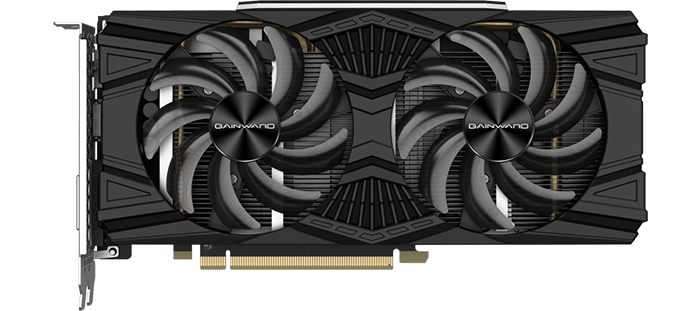
1.410 GHz, 8 GB (175 W TDP)
Buy this graphic card at amazon!

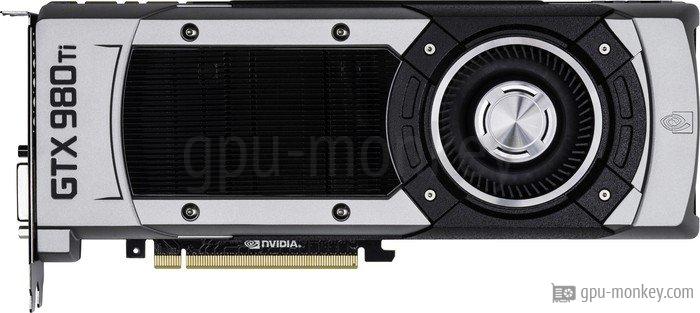
1.000 GHz, 6 GB (250 W TDP)
Buy this graphic card at amazon!
Rate these graphics cards now
Benchmark results
3DMark Benchmark (DirectX, Raytracing)
3DMark is a benchmark program that determines the performance of certain components of a computer and then reports the performance as a numerical value.
Time Spy Extreme Graphics score

|
Gainward GeForce RTX 2070
8 GB GDDR6 |
||

|
PNY GeForce GTX 980 Ti
6 GB GDDR5 |
||
Port Royal (Raytracing)
|
|
Gainward GeForce RTX 2070
8 GB GDDR6 |
||
Speed Way Graphics Score (Raytracing)
|
|
Gainward GeForce RTX 2070
8 GB GDDR6 |
||
Cyberpunk 2077
Cyberpunk 2077 was developed by CD Projekt Red and is based on the development studio's own REDengine 4. Ray tracing is switched off in our benchmarks.
3840x2160 (2160p)
|
|
Gainward GeForce RTX 2070
8 GB GDDR6 |
||
2560x1440 (1440p)
|
|
Gainward GeForce RTX 2070
8 GB GDDR6 |
||
1920x1080 (1080p)
|
|
Gainward GeForce RTX 2070
8 GB GDDR6 |
||
Battlefield 5
Battlefield 5 is a visually stunning game that is ideal as a graphics card benchmark. We test the game with maximum details on Windows 10.
3840x2160 (2160p)
|
|
Gainward GeForce RTX 2070
8 GB GDDR6 |
||
2560x1440 (1440p)
|
|
Gainward GeForce RTX 2070
8 GB GDDR6 |
||
1920x1080 (1080p)
|
|
Gainward GeForce RTX 2070
8 GB GDDR6 |
||
Geekbench 6 (OpenCL, Vulkan, Metal)
Geekbench 6 is a cross-platform benchmark for main processors, which also carries out 3 different graphics benchmarks and outputs them in the form of a numerical value.
Geekbench 6 - OpenCL
|
|
Gainward GeForce RTX 2070
8 GB GDDR6 |
||
|
|
PNY GeForce GTX 980 Ti
6 GB GDDR5 |
||
Geekbench 6 - Vulkan
|
|
Gainward GeForce RTX 2070
8 GB GDDR6 |
||
|
|
PNY GeForce GTX 980 Ti
6 GB GDDR5 |
||
FP32 Performance (Single-precision TFLOPS)
The theoretical computing power of the graphics card with single precision (32 bit) in TFLOPS indicates how many trillion FP32 floating point operations the graphics card (GPU) can perform per second.
FP32 (TFLOPS)
|
|
Gainward GeForce RTX 2070
8 GB GDDR6 |
||
|
|
PNY GeForce GTX 980 Ti
6 GB GDDR5 |
||
Popular comparisons


