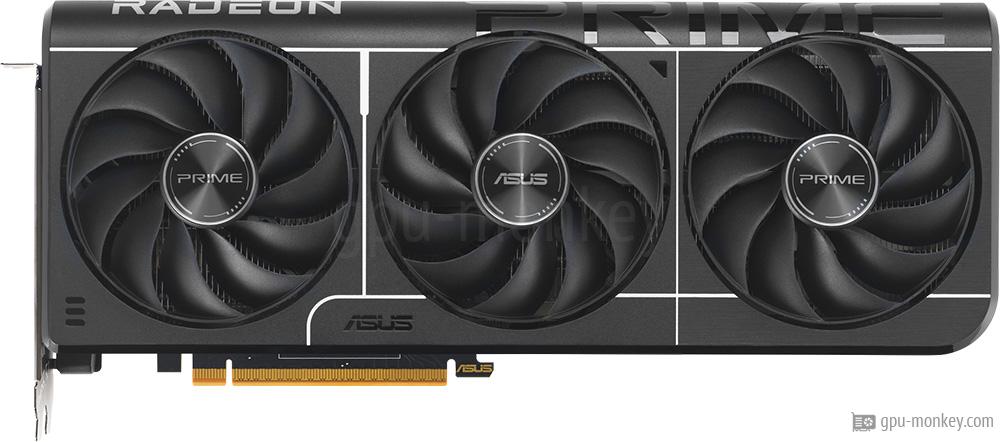
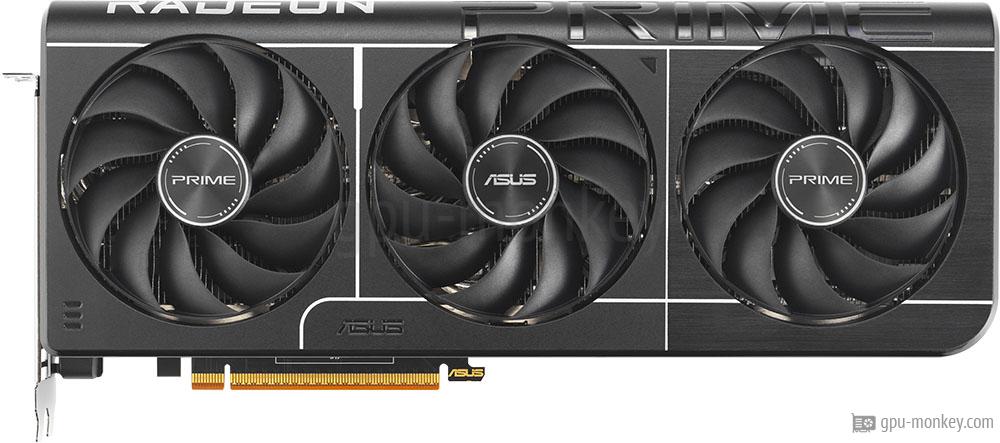
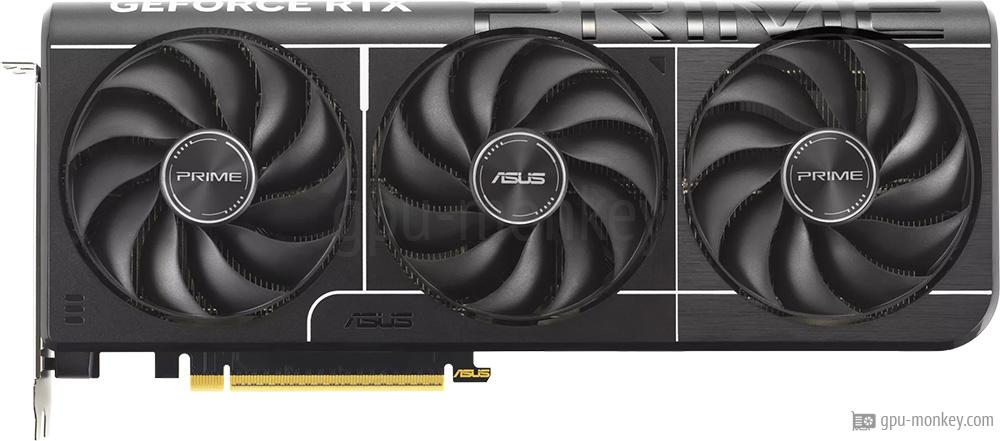
The ASUS Prime Radeon RX 9070 OC Edition 16GB has 56 execution units with 3584 shaders. This gives the graphics card a theoretical FP32 computing power of 37.42 TFLOPS.
- GPU Chip
- Navi 48 XT (RDNA 4)
- Streaming Multiprocessors
- 56
- Shader
- 3584
- Render Output Units
- 128
- Texture Units
- 224
- Raytracing Cores
- 56
The ASUS Prime Radeon RX 9070 OC Edition 16GB is equipped with 16 GB graphics memory of the type GDDR6. The memory clock of the graphics card is 2.518 GHz and the speed is 20.1 Gbps.
- Memory Size
- 16 GB
- Memory Type
- GDDR6
- Memory Clock
- 2.518 GHz
- Memory Speed
- 20.1 Gbps
- Memory bandwidth
- 645 GB/s
- Memory Interface
- 256 bit
The base frequency of this graphics card is 1.330 GHz and the manufacturer specifies the maximum turbo clock as 2.610 GHz. If supported (see below), the performance can be further increased by overclocking.
- Base Clock
- 1.330 GHz
- Boost Clock
- 2.610 GHz+4 %
- Avg (Game) Clock
- 2.140 GHz+3 %
- Overclocking
- Yes
The ASUS Prime Radeon RX 9070 OC Edition 16GB is powered by 2 x 8-Pin connectors. The TDP (Thermal Design Power) of the graphics card is 220 W.
- TDP
- 220 W (Reference)
- Tjunction max
- 85 °C
- PCIe-Power
- 2 x 8-Pin
Graphics processor and graphics memory of the ASUS Prime Radeon RX 9070 OC Edition 16GB are cooled by a Air cooling.
- Fan-Type
- Axial
- Fan 1
- 3 x 92 mm
- Cooler-Type
- Air cooling
- Noise (Idle)
- 0 dB / Silent
Up to 4 monitors can be operated with the ASUS Prime Radeon RX 9070 OC Edition 16GB.
- Max. Displays
- 4
- HDCP
- 2.3
- HDMI
- 1x HDMI 2.1b
- DisplayPort
- 3x DP 2.1a
With the ASUS Prime Radeon RX 9070 OC Edition 16GB it is possible to operate a screen with a resolution of up to 7680x4320 pixels. Furthermore, the DirectX standard version 12_2 (Ultimate) is supported.
- Max. resolution
- 7680x4320
- DirectX
- 12_2 (Ultimate)
- Raytracing
- Yes
- DLSS / FSR
- Yes
- LED
- No LED lighting
This area lists the video codecs that the ASUS Prime Radeon RX 9070 OC Edition 16GB can decode or encode in hardware in order to minimize the processor load, which leads to lower power consumption.
- h264
- Decode / Encode
- h265 / HEVC
- Decode / Encode
- VP8
- Decode / Encode
- VP9
- Decode / Encode
- AV1
- Decode / Encode
The ASUS Prime Radeon RX 9070 OC Edition 16GB needs the space of 3 PCIe-Slots in a case. It is 312 mm long, 130 mm high and 50 mm wide.
- Length
- 312 mm
- Height
- 130 mm
- Width
- 50 mm
- Width (Slots)
- 3 PCIe-Slots
- SFF-Ready
- No
The ASUS Prime Radeon RX 9070 OC Edition 16GB was released in Q2/2025 at a price of 549 $. The graphics card manufactured in 4 nm is connected to the system via PCIe 5 x 16 lanes.
- GPU Interface
- PCIe 5 x 16
- Release date
- Q2/2025
- Launch Price
- 549 $ (Reference)
- Structure size
- 4 nm
- Part-no
- PRIME-RX9070-O16G