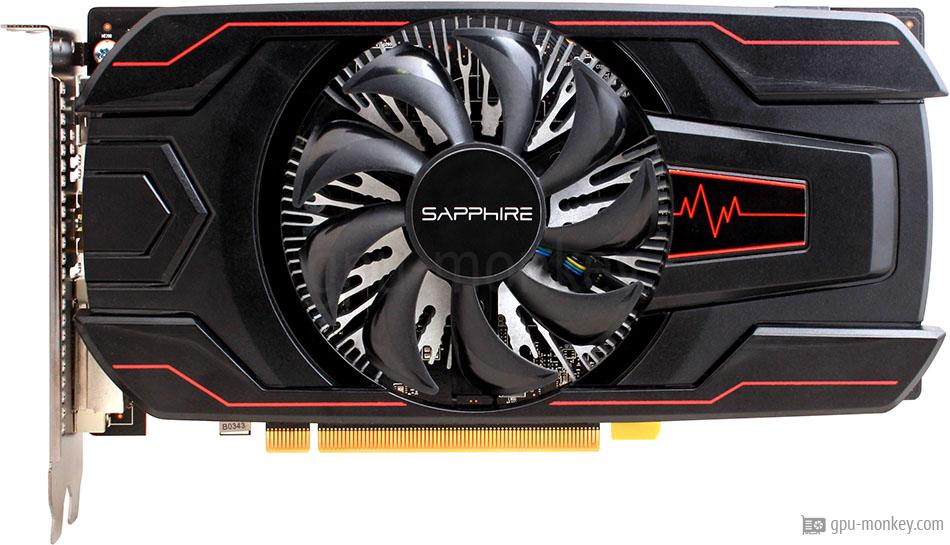
The SAPPHIRE PULSE Radeon RX 560 4G G5 16CU has 1024 shaders and 16 execution units. The graphics card thus achieves a theoretical FP32 computing power of 2.38 TFLOPS.
- GPU Chip
- Polaris 21 XT (GCN 4)
- Streaming Multiprocessors
- 16
- Shader
- 1024
- Render Output Units
- 16
- Texture Units
- 64
The SAPPHIRE PULSE Radeon RX 560 4G G5 16CU can use 4 GB graphics memory of the type GDDR5. The graphics card thus achieves a memory bandwidth of 112 GB/s on a 128 bit wide memory interface.
- Memory Size
- 4 GB
- Memory Type
- GDDR5
- Memory Clock
- 1.750 GHz
- Memory Speed
- 7.0 Gbps
- Memory bandwidth
- 112 GB/s
- Memory Interface
- 128 bit
The base clock frequency of the SAPPHIRE PULSE Radeon RX 560 4G G5 16CU is 1.090 GHz. A high clock frequency (even in turbo mode) can greatly increase the speed of a graphics card.
- Base Clock
- 1.090 GHz-7 %
- Boost Clock
- 1.300 GHz+2 %
- Overclocking
- Yes
The TDP (Thermal Design Power) of the SAPPHIRE PULSE Radeon RX 560 4G G5 16CU is 90 W. The graphics card is supplied with energy via the 1 x 6-Pin connector.
- TDP
- 90 W+20 %
- Tjunction max
- 97 °C
- PCIe-Power
- 1 x 6-Pin
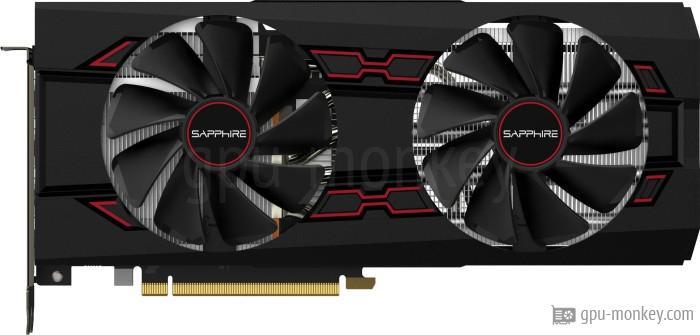
The SAPPHIRE PULSE Radeon RX 560 4G G5 16CU has a total of 1 Axial fans to cool the graphics processor and graphics memory.
- Fan-Type
- Axial
- Fan 1
- 1 x 90 mm
- Cooler-Type
- Air cooling
- Noise (Idle)
- 0 dB / Silent
Up to 4 screens can be connected to the SAPPHIRE PULSE Radeon RX 560 4G G5 16CU.
- Max. Displays
- 4
- HDCP
- 2.2
- HDMI
- 1x HDMI 2.0
- DisplayPort
- 1x DP 1.4
- DVI
- 1
The SAPPHIRE PULSE Radeon RX 560 4G G5 16CU has a maximum resolution of 5120x2880 pixels. The graphics card supports the DirectX 12 standard.
- Max. resolution
- 5120x2880
- DirectX
- 12
- Raytracing
- No
- DLSS / FSR
- Yes
- LED
- No LED lighting
The video codecs accelerated in hardware by the SAPPHIRE PULSE Radeon RX 560 4G G5 16CU reduce the processor load and ensure lower energy consumption.
- h264
- Decode / Encode
- h265 / HEVC
- Decode / Encode
- VP8
- Decode
- VP9
- Decode
- AV1
- No
The SAPPHIRE PULSE Radeon RX 560 4G G5 16CU is 210 mm long and 112 mm high. With a width of 36 mm, the graphics card requires 2 PCIe-Slots in the case.
- Length
- 210 mm
- Height
- 112 mm
- Width
- 36 mm
- Width (Slots)
- 2 PCIe-Slots
- SFF-Ready
- No
The SAPPHIRE PULSE Radeon RX 560 4G G5 16CU made in 14 nm was published in Q3/2017 for 99 $.
- GPU Interface
- PCIe 3.0 x 8
- Release date
- Q3/2017
- Launch Price
- 99 $ (Reference)
- Structure size
- 14 nm
- Part-no
- 11267-00